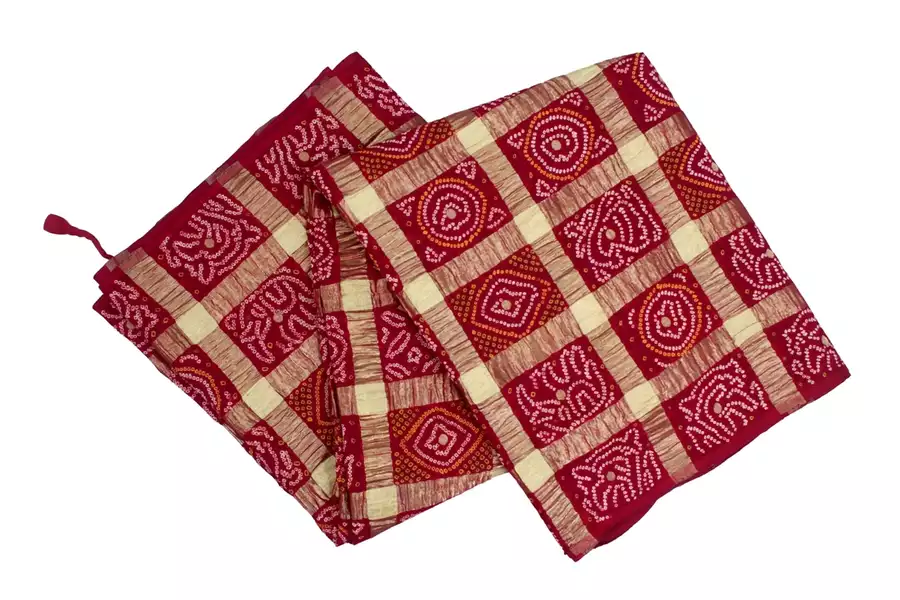
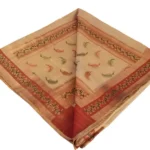
Gatchola Saree
Category: Saree
Type: Wedding Ghatchola Saree
Technique: Weaving, Tie & Dye
Material: Silk & Zari
Dimensions: L 5m 29cm W 1m 20cm
Provenance: Gujrat, Surendra Nagar Area
Period: Mid 20th Century
Description
It’s a Ghatchola saree prepared for wedding. A tissue is a material where the warp is of Silk and weft is of Zari. Its border has traditional zig-zag motif called ‘Leheriya’. These two bands in the border where in creeper is made between two bands. The Pallava is made of two bands and alternative red and green leaves. The ‘Kairi’ pattern is made with ‘Tilli’ technique.
A Banarasi saree is a saree made in Varanasi, a city which is also called Benares or Banaras. The sarees are among the finest sarees in India and are known for their gold and silver brocade or zari, fine silk and opulent embroidery. The sarees are made of finely woven silk and are decorated with intricate design, and, because of these engravings, are relatively heavy.
Their special characteristics are Mughal inspired designs such as intricate intertwining floral and foliate motifs, Kalga and Bel, a string of upright leaves called Jhallar at the outer, edge of border is a characteristic of these sarees. Other features are gold work, compact weaving, figures with small details, metallic visual effects, pallus, Jal (a net like pattern), and Mina work.
The sarees are often part of an Indian bride’s trousseau.
It’s been made by Tie & Dye technique. Double colours are used in this red and yellow. The grain size is not regular because either pulse grain or jwar grain is used. All patterns are irregular and motifs used are of flowers and elephant in a quite irregular manner. The dying of this saree had been done from lighter shade to darker shade. Firstly it’s dyed in yellow colour and then in red.The areas which are appearing darker have silk in warp thread and zari in weft. In pure golden areas only silk is used in both warp & weft. Brocading is done by using shuttle and dobby whereas the central embroidery called ‘paisa booti’ is done with ‘tilli’.