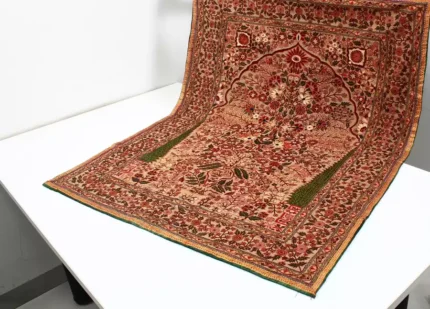
Banarasi Saree
Kari Pattern
Type: Banarasi Saree
Technique: Weaving, Banaras brocade
Material: Tissue, Silk and Brocade
Dimensions: L: 4m86.5cm; W: 1m16.5cm; Border: 11.5cm
Provenance: Banaras, UP
Period: Mid 20th Century
Condition: Good
Description
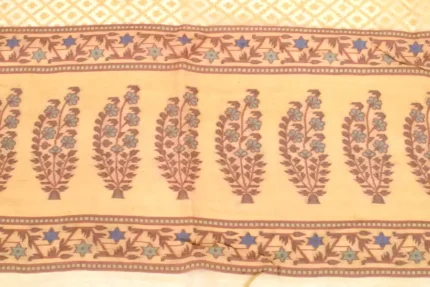
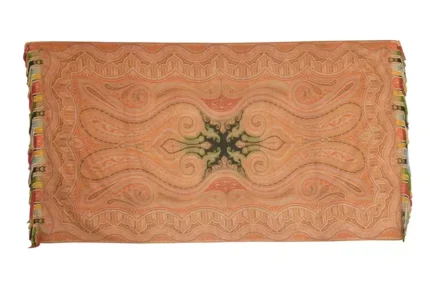
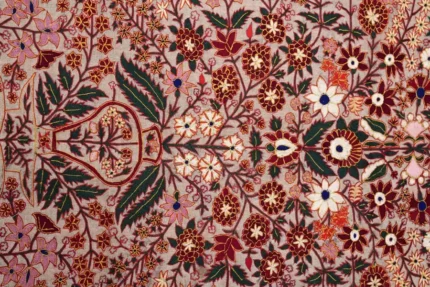
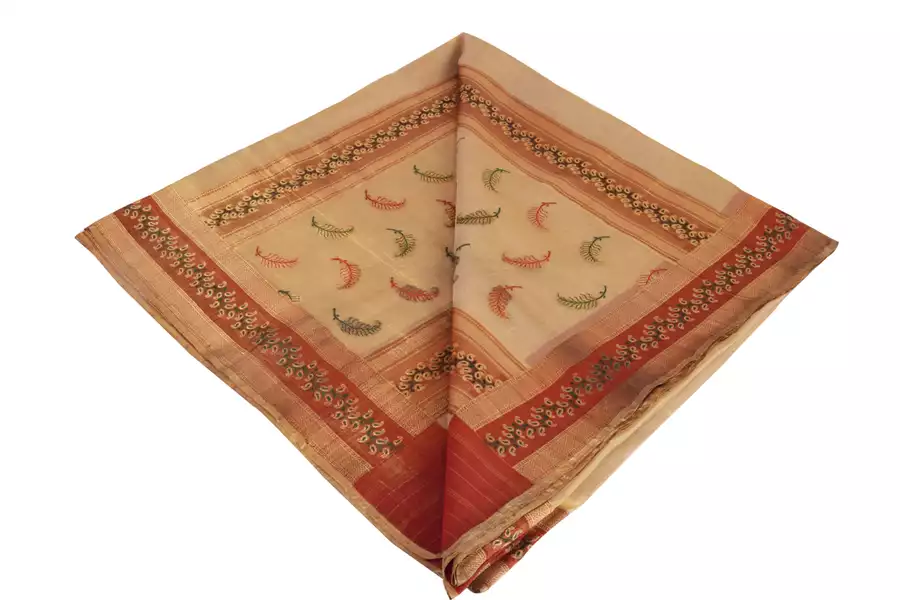
Tissue is a material where warp is of Silk and weft is of Zari. Its border has traditional zig-zag motif called ‘Leheriya’. There two bands in the border where in creeper is made between two bands. The pallav is made of two bands and alternative red and green leaves. The ‘Kairi’ pattern is made with ‘Tilli’ technique.
A Banarasi saree is a saree made in Varanasi, a city which is also called Benares or Banaras. The sarees are among the finest sarees in India and are known for their gold and silver brocade or zari, fine silk and opulent embroidery. The sarees are made of finely woven silk and are decorated with intricate design, and, because of these engravings, are relatively heavy.
Their special characteristics are Mughal inspired designs such as intricate intertwining floral and foliate motifs, Kalga and Bel, a string of upright leaves called Jhallar at the outer, edge of border is a characteristic of these sarees. Other features are gold work, compact weaving, figures with small details, metallic visual effects, pallus, Jal (a net like pattern), and Mina work.
The sarees are often part of an Indian bride’s trousseau.